
The AI Native Gap
Hard to believe ChatGPT’s “Ask me anything” appeared just over two years ago. I lived through clunky PCs, brick cell phones, and dial-up modems — they were remarkable, but they took years to evolve to being as friction-free as AI.
AI = Instant consumer delight. Your first experience usually ends with jaw-dropped “Wow!” Misspell instructions, still get great insights. Get complex issues explained like you’re in 5th grade. Create avatars, edit videos, learn a new skill, fact check with speed. Speak a website into existence. It does have ‘anything’ well covered.
The investment ecosystem is unprecedented. Unlike dot-com’s inflated valuations built on “eyeballs” with little investments, today’s AI revolution has serious capital supporting capacity gap vs. 2030: chips (4X), energy (3x), talent (2.6X more roles, unprecedented salary offers).
It’s not just supply-side investment — demand-side economics are fascinating too. AI is so accessible that most of it’s free! Users create meme pics for fun, the link between usage and cost is broken. Expect things will evolve to a pay per use model over time but for now it’s fun for free or low subscription costs!
There is another aspect that fascinates me: “com-partner-tition”. Management books will need new chapters on this. Apple using both OpenAI and now Google. Microsoft playing Co-pilot & partnering OpenAI. Amazon partnering OpenAI and Anthropic. Historical exclusivity biases? Gone. And this spirit is leaking into the geo-political space — rare-earth security, cross-border investments and access to chips are all core to geo-political dialogue and muscle flexing.
So: great products, serious investment, massive supply scaling, geo-political priority. And most agree, while the builders will take time to get to profit, the real winners will be the “users”. In a world with 6 Billion plus internet users and nearly 5 billion smartphones, AI adoption should be exploding.
Yet global AI tool usage remains 16.3% — just about a Billion! Worse — people using it barely scratch the surface. It’s like a Ferrari driven in first gear in Bangalore traffic, used way below its potential.
Here’s my take on what’s missing: Growth mindsets. Measurable outcomes. Change Management.
Corporations
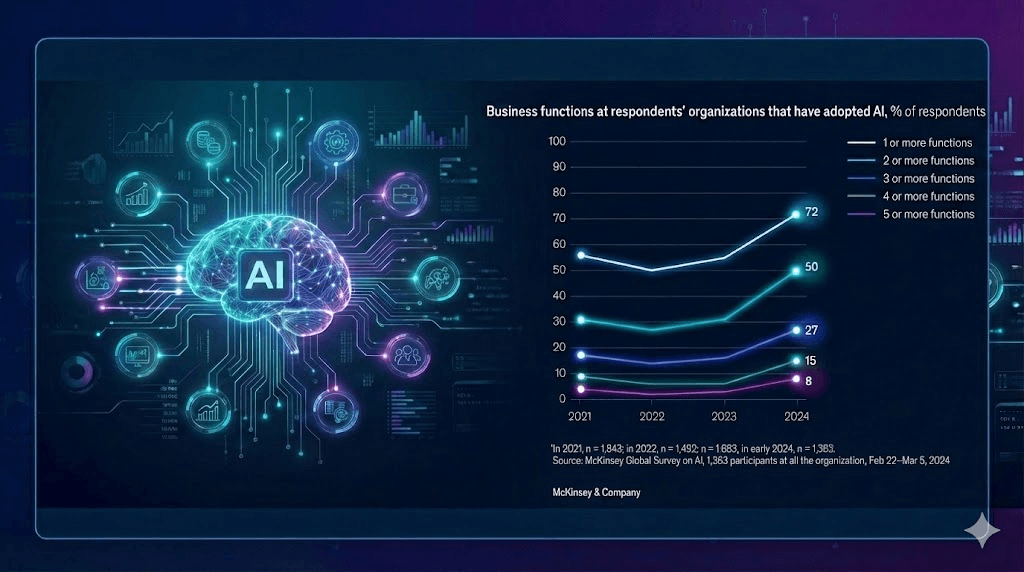
McKinsey’s 2024 study shows 72% of organizations have adopted AI in at least one function — but only 15% use it across four functions, and just 8% across five or more. This gap reveals the real problem. While start-ups embrace latest trends easily, legacy giants drown in territorial battles — global vs. local, IT vs. functions.
Focusing on opportunistic use cases instead of end-to-end reimagination creates a mirage of AI comfort that comes from short-term productivity. Re-skilling, upskilling, leadership hands-on commitment to building a learning culture — these are non-negotiables. The irony? Even big AI companies still use email-based employee surveys that take 3-5 months to process and review in the rear-view mirror vs. realtime.
Individuals
Three patterns I’ve seen: “Fear” of not being a techie handcuffs intent. Second: “I don’t have time” — like the woodcutter too busy cutting with a blunt saw to stop and sharpen it. The third: “Pseudo-expertise” — a bias to show vs. learn — writing a poem using ChatGPT doesn’t make you AI-literate.
We have digital natives. We don’t yet have AI natives — but they’re coming — corporates and people, and they’ll make non-natives obsolete. The window to stay relevant is narrow.
How many of you are using AI daily? Not just trying it — actually integrating it into your work and your life?
My challenge: Add “purposeful AI usage education” to your personal development in 2026. Not dabbling. Deep, intentional learning. For perspective, not expertise! It’s not late — you will still be ahead of 80% of the population.
Originally published on LinkedIn