
Retiring the Lens Built for India 1961
Q4 FY26 earnings: India FMCG majors delivered strong revenue and profit growth — some even double-digits despite scale. Key messages: Rural is “outpacing urban.” Urban + modern trade + e-commerce & quick commerce is “showing momentum.”
Good news. But segmenting the continent of India as old urban vs. rural in 2026 just feels wrong.
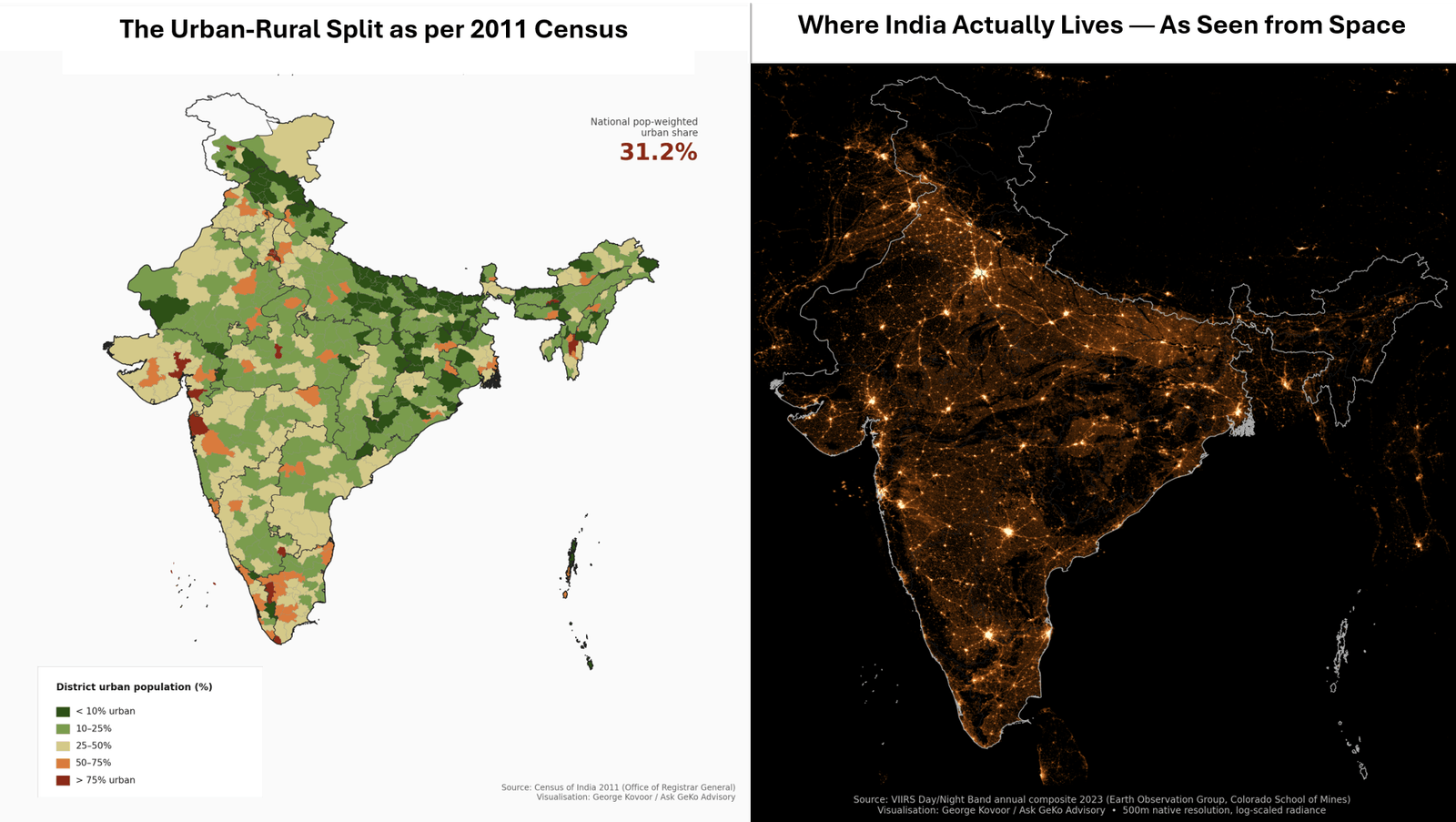
Look at the map on the right. Find the urban-rural border. You can’t. It certainly does not look like the census map on the left.
India’s lit web is continuous. Yet FMCG India Inc. speak is still mostly anchored to the 2011 Census split of 32:68 — built on a definition drafted in 1961: 5,000+ people, 400/sqkm, 75% non-farm male workers. A decade of infrastructure and the digital stack have quietly made those definitions irrelevant.
The Economic Survey 2025-26 cites European Commission satellite data showing India was already 63% urban — in 2015. The World Bank reached the same conclusion a decade earlier.
Do the math. The gap between census-urban and satellite-urban is roughly 430 million Indians still being planned for as rural — who already behave urban.
Some call it “rurban.” The real surge is in traditionally classified rural markets sitting in the gravitational force-field of urban India.
My driver Balram lives in a “rural-classified” part of Delhi. International school for the kids. iPhone 15 on EMI for his wife. Annual pilgrimage trips. No savings, plenty of debt, large family support — a consumption appetite nothing like the rural archetype FMCG planners still build around.
Rurban consumers — many urban migrants — aspire to everything urban while tethered to the affordability trap and the values of large traditional families. The landscape is a mosaic: Premium and value share the same basket. Indulgence and function share the same shelf. Omni-channel is a way of life. Delivery expectations at the speed of now.
Traditional rural still exists, and infrastructure is finally reaching it. But counting villages covered without separating those caught in the urban agglomeration wave is how the real growth opportunity gets missed.
At Ask GeKo Advisory, I draw on 34 years inside this industry to help clients build cluster segmentation that maps to the actual shape of demand — by access, aspiration, and consumption velocity, not by a census line drawn before colour TV reached India.
Winning India 2030 starts with retiring the lens built for India 1961.
Originally published on LinkedIn