
'It Has Never Happened Here' Is Not a Risk Assessment
Last week Europe got a heat shock. Populations that were proud of never needing air conditioning were suddenly jostling for units as manufacturers struggled to keep up. We’ve heard these “one-offs” before, haven’t we? Snow storms in Texas. Heat waves in southern China. Floods where floods never happened. Clearly they are not one-offs. And they are disruptive and expensive.
Climate has been needlessly politicized. One camp sounds the Armageddon siren. The other dismisses it all as noise designed to choke business with regulation. Both miss what a manager should see first: this is a risk conversation, not an ideology contest.
And here most boardrooms have the aperture set too narrow. Scope 1-2-3 reporting, renewables, packaging impact. Necessary, but not sufficient for risk management. The wider questions go unasked. What happens when a critical supply source floods, in a geography where flooding was never on the risk register? Do HR policies protect a frontline team working streets at 50 degrees? Were capex specifications for wiring, insulation and fire tolerance written for a climate that no longer exists?
A lecture by Spencer Glendon, founder of Probable Futures, reframed this for me. After roughly 12,000 years of stable climate, we are moving to a new normal. Argue about the cause if you must. The change itself is not arguable. And the shift is deceptively small: just a few extreme days a year, of new levels of heat, rain or storm. Managing those few days is the boardroom conversation. It is also the core of how we think about enterprise risk at Ask GeKo Advisory: map climate probability across the end-to-end supply chain, not just the office rooftop.
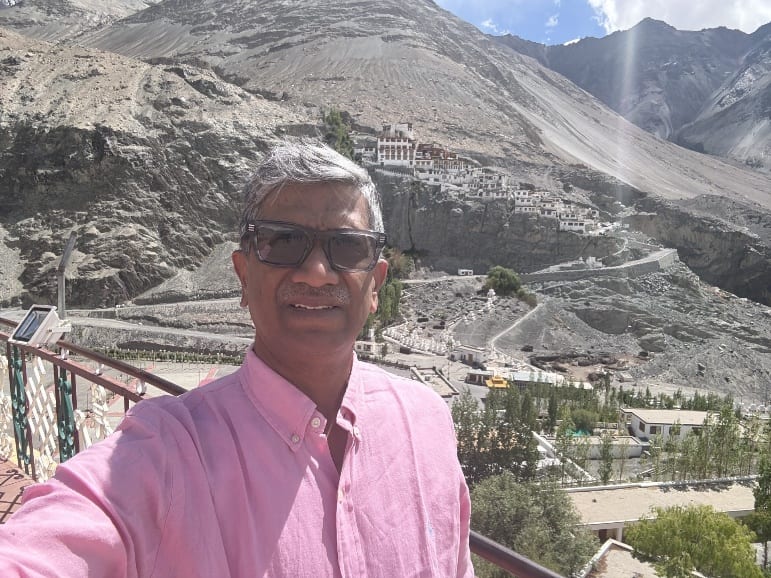
I felt it personally last week in Nubra Valley, Ladakh, a high-altitude desert where air conditioning was never needed. Leh’s summers historically ranged 15 to 25 degrees. Today, 30-degree days arrive every June and July, the region logged an all-time high near 40 degrees in 2024, and flights out of Leh have been cancelled for heat. Not snow. Heat.
Ladakh will stay more cold than warm. But the pendulum swings further than it used to. Every enterprise has a Nubra somewhere, a place where the answer has always been “that never happens here.”
“It has never happened here” is not a risk assessment. It is the absence of one.
Originally published on LinkedIn