
Growth is Granular
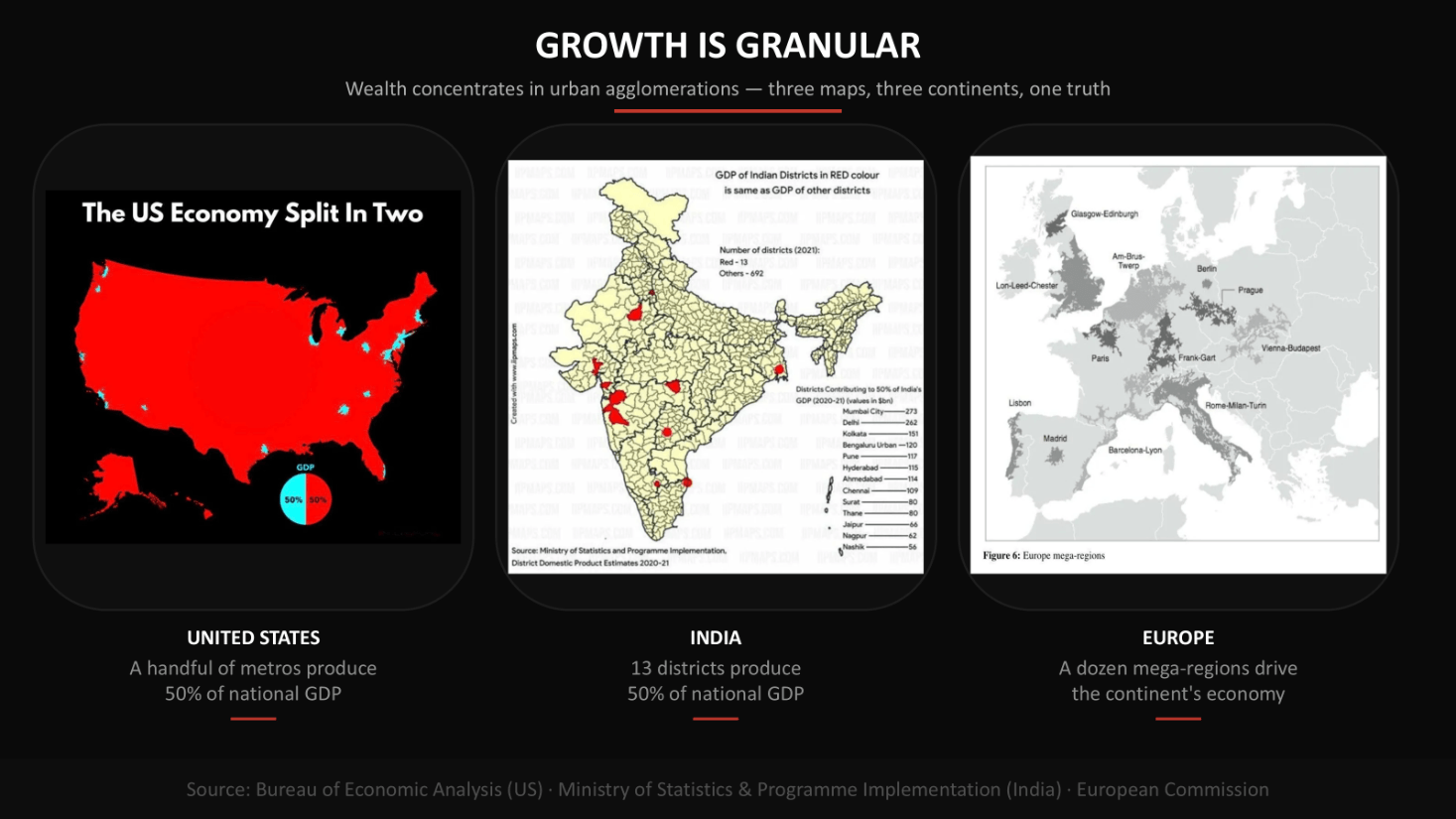
13 districts produce 50% of India’s GDP. A handful of US metro areas match the output of the entire rest of the country. Europe’s economic engine runs on a dozen mega-regions. Three maps, three continents, one truth: wealth concentrates in urban agglomerations — and these clusters don’t respect state borders, city limits, or any political boundary. They are simply where infrastructure, aspiration, and spending power converge. Call them what they are: demand clusters.
McKinsey popularized “Growth is Granular” nearly 2 decades ago. Yet most companies still plan, resource, and review their businesses at altitudes where this concentration and fragmentation is invisible.
The challenge isn’t data — it’s the lens. Statements like “UP is a must-win” or “we need to crack rural” sound strategic at 50,000 feet but fail to become tangible without granular resourcing and execution. The shape of growth in high-infrastructure, high-aspiration markets — where retail density, transportation access, and real estate development converge — looks nothing like the shape of growth in geographies lagging in such development. Portfolio mix, pricing architecture, channel economics, and consumption occasions are fundamentally different.
Some businesses have figured this out. Q-commerce players in India shattered traditional segment definitions by building demand models at the sub-zip-code level. Mall operators and restaurant chains have long built proprietary location intelligence. Yet much of FMCG remains anchored to legacy segmentation — proudly sitting on imprecise “granular” store-level data covering a fraction of India’s 12-13 million outlets, while research providers still slice distribution, share, and execution data by state, city, and “urban/rural” definitions — none of which map to actual demand clusters.
The result? FMCG growth consistently trailing GDP despite massive headroom in penetration, frequency, and transaction value.
I’ve seen what happens when you fix this lens. When we reframed how we segmented and resourced growth in China, the business grew 5X in a decade. Helping CEOs re-tool their growth lenses for a transforming world is now central to the advisory work I do through Ask GeKo & Co.
AI and digital intelligence now make it possible to fundamentally reimagine how we cluster, segment, and resource markets. This isn’t a “nice to have” — companies that crack this will be richly rewarded. Those that don’t will keep wondering why their strategy looks great at 50,000 feet but never lands on the ground.
Originally published on LinkedIn